Summary:
Most people don’t think about their chimney liner until they smell something they can’t explain, or smoke starts drifting back into the room. By that point, the liner has usually been deteriorating for a while — quietly, out of sight, inside the flue where no one thinks to look.
If you live in Rhode Island and your home is more than a few decades old, there’s a real chance your liner is either overdue for inspection or already showing signs of wear. We’ve seen this pattern repeatedly across Providence, Pawtucket, Woonsocket, and smaller towns throughout the state. This guide covers what to look for, why Rhode Island’s specific conditions make liner damage more common than most homeowners realize, and what the replacement process actually looks like.
Your chimney liner does two jobs that most homeowners never think about. First, it channels combustion gases — including carbon monoxide — safely out of your home. Second, it acts as a barrier between the intense heat inside the flue and the wood framing and other combustible materials surrounding your chimney.
When the liner is intact, those two functions happen automatically every time you use your fireplace or heating appliance. When it’s cracked, deteriorated, or missing entirely, both functions are compromised. Heat can transfer through damaged tiles into the surrounding structure, and gases that should be venting outside can seep back into your living space instead.
Liner failure isn’t always dramatic. It usually happens gradually — through age, moisture intrusion, and the kind of freeze-thaw cycling that Rhode Island winters deliver season after season.
The tricky part about chimney liner damage is that most of it happens where you can’t see it. The flue is a dark, narrow space, and even a significant crack in a clay tile liner won’t announce itself from the outside. What you’re more likely to notice are the downstream effects — the symptoms that show up in your home before you ever think to look at the liner itself.
One of the most common is a persistent smoky or musty odor coming from the fireplace when it isn’t in use. That smell isn’t just unpleasant — it’s a sign that gases are finding their way back into the living space through gaps or cracks in the liner. If you’re noticing it in warm weather, when the fireplace has been dormant for months, that’s worth taking seriously.
Smoke backdraft is another clear signal. If smoke consistently rolls back into the room when you light a fire, rather than drawing up and out through the flue, a damaged or improperly sized liner is often the cause. A functioning liner creates the draft that pulls combustion gases upward. When that seal is broken, the draft fails.
Take a look inside your firebox. If you’re finding small fragments of clay, tile, or masonry that weren’t there before, those pieces are coming from somewhere — and the most likely source is a deteriorating clay tile liner shedding material as it breaks apart. That’s not a cosmetic issue. That’s the liner physically failing.
Efflorescence — the white, chalky staining that appears on the exterior surface of brick chimneys — is another indicator worth understanding. It forms when moisture moves through the masonry and deposits mineral salts on the surface as it evaporates. A cracked or failed liner allows moisture to penetrate the chimney structure in ways it shouldn’t, and efflorescence is often the visible result. It won’t wash off easily, and it tends to return even after cleaning, because the underlying moisture problem is still active.
Finally, if your heating bills have crept up without an obvious explanation, a compromised liner could be contributing. A properly functioning liner helps your heating system draft efficiently. When that efficiency is lost, your furnace or boiler works harder to compensate — and you pay for it.
Rhode Island’s climate is harder on chimney liners than most homeowners realize, and it’s not just because of cold winters. The real issue is the combination of factors that make this state’s conditions uniquely destructive to masonry and flue systems.
Start with the freeze-thaw cycle. Rhode Island winters don’t deliver the sustained deep freezes you’d find further north — instead, temperatures tend to hover near the freezing point and cross it repeatedly, sometimes multiple times in a single day. Every time moisture inside a clay tile liner or mortar joint freezes, it expands by roughly nine percent. That expansion creates pressure from within the material. Over dozens of cycles in a single winter, that pressure accumulates. Cracks form, tiles shift, and mortar joints fail.
Now add maritime humidity. Rhode Island’s proximity to Narragansett Bay means the air carries significantly more moisture than inland climates. That moisture saturates masonry continuously — not just during rain events, but persistently throughout the heating season. Clay tile liners that might last longer in a drier climate deteriorate faster here because they’re never fully dry between cycles.
Coastal communities face an additional layer of stress. In towns like Bristol, Barrington, Narragansett, and Newport, salt air accelerates corrosion on metal liner components, chimney caps, and flashing. If your home is within a few miles of the water, that’s a factor worth factoring into your inspection timeline.
Then there’s the housing stock itself. Rhode Island has one of the oldest collections of residential homes in the country. Chimney liners weren’t required by code until 1945, which means any home built before that date may have no liner at all — just an unlined masonry flue. Many others were built in the post-war decades with clay tile liners that are now sixty to eighty years old. Those liners were never designed to last indefinitely, and most have long since passed their serviceable lifespan. In older neighborhoods across Providence, Pawtucket, Woonsocket, and Central Falls, this is less an edge case than a common reality.
Want live answers?
Connect with a Certified Chimney Inspections expert for fast, friendly support.
Once a damaged liner is identified, the next question is what to do about it. In some cases — minor and localized damage — repair may be sufficient. But when the liner is cracked throughout, significantly deteriorated, or simply absent, replacement is the right answer.
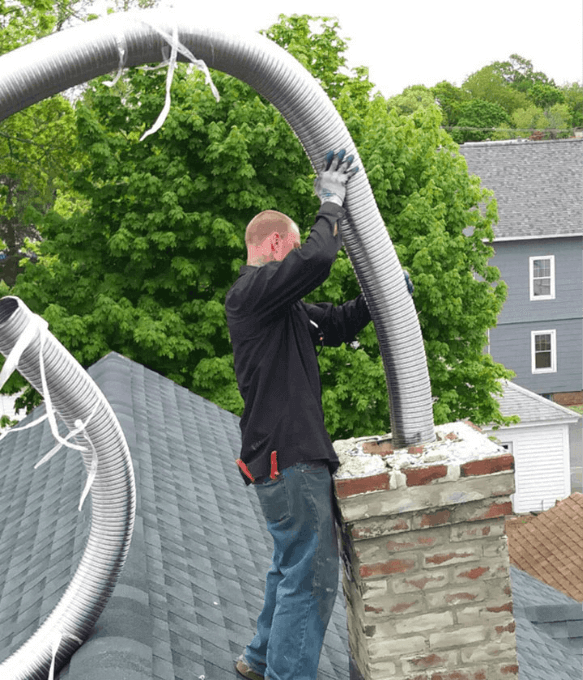
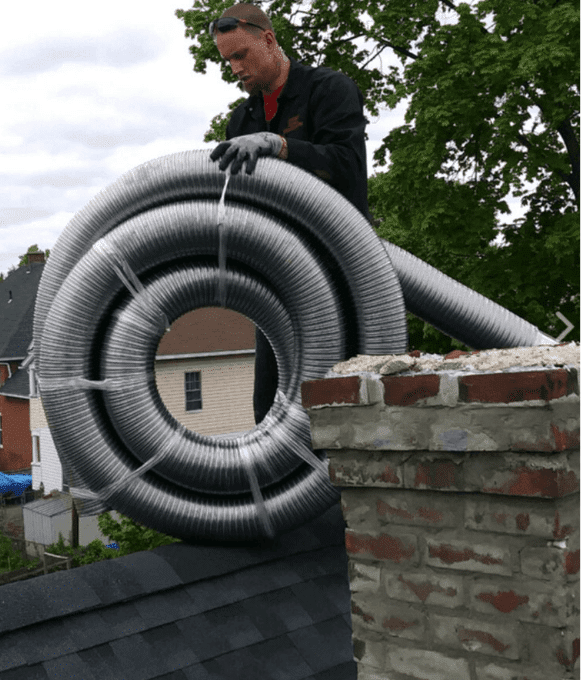
The most common replacement option for Rhode Island homes is a stainless steel flexible liner. It works with all fuel types, handles the demands of a high-use heating system, and comes with a lifetime warranty that transfers to new homeowners if you ever sell. Installation typically takes four to eight hours and doesn’t require major disruption to your home.
The cost of chimney liner replacement in Rhode Island generally falls between $1,500 and $4,000, depending on chimney height, accessibility, liner diameter, and whether the existing clay tiles need to be removed before the new liner can be installed.

It’s a fair question, and the honest answer is: sometimes. If the damage is isolated — a single cracked section, a small gap in an otherwise sound liner — repair may be a reasonable option. A cast-in-place liner application, for example, can restore structural integrity to a chimney with widespread but not catastrophic deterioration. It involves applying a specialized concrete mixture to the interior of the flue, forming a seamless, reinforced surface that effectively creates a new liner inside the old one.
The challenge is that liner damage is rarely as isolated as it appears from the outside. Because the flue is not directly visible, the only reliable way to assess the full extent of the damage is with a camera inspection — running a specialized video system down the flue to document the actual condition of the liner from top to bottom. What looks like a small problem at the firebox opening sometimes turns out to be widespread tile failure throughout the full height of the chimney.
This is why we include a free chimney inspection with every service we provide. You shouldn’t have to pay for an assessment just to find out what you’re dealing with. A thorough camera inspection gives you a clear picture of the liner’s actual condition — and from there, we can give you an honest recommendation. If repair is the right call, we’ll tell you. If the liner needs to come out and be replaced, we’ll explain why and walk you through the options.
It’s also worth noting that any change to your heating appliance — adding a gas insert, upgrading to a new wood stove, switching fuel types — requires a reassessment of your liner. Liner sizing must match the appliance. If you’ve recently had a new appliance installed and the liner wasn’t evaluated as part of that process, it’s worth having it checked.
One thing we’d caution against: DIY liner installation. Beyond the technical complexity, it may not comply with Rhode Island Mechanical Code requirements, and an improperly installed liner can create the exact hazards you’re trying to prevent — carbon monoxide intrusion, inadequate draft, and fire risk. Professional installation ensures proper sizing, secure connections, and code compliance from the start.
The short answer is annually — and that recommendation isn’t arbitrary. NFPA 211, the national fire safety standard that governs chimney systems, calls for annual inspections. Many homeowner insurance policies echo that requirement, meaning that skipping inspections could affect your coverage in the event of a chimney-related incident.
For Rhode Island homeowners specifically, annual inspections matter more than they might in a drier or less demanding climate. The freeze-thaw cycling, persistent humidity, and aging housing stock we discussed earlier all contribute to a faster rate of deterioration than you’d see in many other parts of the country. A liner that looked fine two years ago may have developed significant cracking over the intervening winters.
The best time to schedule an inspection is in the fall, before you start using the fireplace regularly for the season. That gives you time to address any issues before they become urgent mid-winter problems. Spring is the second-best window — a post-winter assessment can catch damage that developed during heavy use before it has a chance to worsen through the following heating season.
We also hear from homeowners after a National Grid visit. Rhode Island’s primary gas utility conducts inspections and shuts off gas service when chimney venting issues are identified. If that’s happened to you, a liner inspection is typically one of the first steps toward getting service restored. It’s a situation we’ve handled many times, and it’s one of the more urgent scenarios we respond to.
If you’ve never had your liner inspected — or it’s been several years — the honest advice is not to wait for a symptom to appear. By the time smoke is coming back into the room or you’re finding tile fragments in the firebox, the liner has already been failing for a while. Early detection is almost always less expensive and less disruptive than waiting until the damage is severe.
Stainless steel liners, installed correctly and maintained with regular inspections, typically last fifteen to twenty years. Clay tile liners in older Rhode Island homes have often already exceeded that timeline. If your home was built before the 1970s and you’ve never had the liner evaluated, that’s where we’d start.
If you’ve recognized any of the warning signs in this guide — unexplained odors, smoke backdraft, tile fragments in the firebox, white staining on your chimney exterior, or rising heating costs — those aren’t things to monitor and revisit later. They’re signals that something inside the flue needs attention now.
Rhode Island’s older housing stock and demanding climate mean liner problems are more common here than many homeowners expect. The good news is that catching them early almost always leads to a simpler, less expensive fix than waiting until the damage compounds.
All of our technicians are CSIA certified, we’ve been doing this work since 2000, and we offer in-house financing for homeowners who need to address a liner issue without waiting on the budget. Free estimates are standard — no pressure, no hidden fees, just a clear picture of what’s going on and what it will take to fix it. Reach out to Certified Chimney Inspections to schedule yours.
Continue learning: