Summary:
Most people don’t think about their chimney liner until a technician tells them there’s a problem — or until National Grid shows up and shuts off their gas. By that point, the situation has gone from routine maintenance to urgent repair. The good news is that chimney liner installation is a well-understood process when it’s handled by someone who actually knows what they’re doing.
This guide covers what a liner does, what your options are, what the installation process looks like, and what Rhode Island homeowners specifically need to keep in mind before making any decisions. We’ve worked through these issues hundreds of times across the state, and we know where the pitfalls are.
A chimney liner is the interior channel running through your chimney that directs combustion gases — carbon monoxide, smoke, water vapor, and other byproducts — safely out of your home. Without a functioning liner, those gases can seep through cracked mortar into living spaces, and heat can transfer into surrounding wood framing in ways that create a serious fire risk.
The liner also protects the masonry itself. Combustion byproducts are corrosive, and without a liner absorbing that punishment, the chimney structure deteriorates much faster. A properly installed liner extends the life of your chimney, improves the efficiency of your heating appliance, and keeps your home’s air quality where it should be.

This is the question most homeowners ask after they’ve been told there’s a problem — and the honest answer is that you usually can’t tell on your own. Liner failure is almost entirely internal. You can’t see a cracked flue tile from the firebox, and you won’t smell a problem until something has already gone wrong.
The only reliable way to assess liner condition is a professional inspection, ideally one that includes a video camera examination of the flue interior. If your home was built before 1940 — which describes a significant portion of Rhode Island’s housing stock, particularly in Providence, Pawtucket, Woonsocket, and the older mill towns throughout the state — there’s a real possibility the original clay tile liner has never been replaced.
Clay tile liners have a finite lifespan, and one that has been in place for 60, 80, or 100 years is almost certainly showing signs of deterioration, whether you can see it or not. Other situations that should trigger an inspection include a recent change to your heating appliance, visible smoke backing up into the room, a gas utility shutoff citing a chimney deficiency, or a real estate transaction requiring a Level 2 inspection.
Rhode Island law doesn’t require a liner inspection at every sale, but NFPA 211 — the national standard governing chimney systems — requires a Level 2 inspection whenever a home changes hands or a new heating appliance is installed. That inspection includes a camera look at the flue interior, and it’s often where liner problems are discovered for the first time.
If you’ve been using your fireplace or heating appliance without a recent inspection, that alone is a reasonable trigger. The liner may be perfectly fine. But you won’t know until someone actually looks.
There are three main categories: clay tile, cast-in-place, and metal (typically stainless steel). Each has a different use case, a different cost profile, and a different performance profile in Rhode Island’s specific conditions.
Clay tile liners are what most older homes already have. They’re durable under ideal conditions, but they don’t handle thermal shock well — meaning rapid temperature changes can cause them to crack. Rhode Island’s freeze-thaw cycling, where temperatures regularly oscillate above and below 32°F throughout the winter months, is particularly hard on clay tile. Water infiltrates hairline cracks, freezes, expands, and widens the crack with each cycle. A liner that looked marginal in November can be structurally compromised by March.
Cast-in-place liners involve pouring a cement-like material inside the existing flue to create a new seamless liner. This approach works well when the existing chimney structure is sound but the liner itself is deteriorated. It’s a good option for irregular flue shapes that are difficult to line with a rigid insert.
Stainless steel liners are the most common choice for new installations and replacements today, and for good reason. They’re durable, they handle the chemistry of modern heating appliances well, and they can be installed in most chimney configurations. Within stainless steel, though, the grade matters — and this is where a lot of contractors get it wrong.
There are two primary grades used in chimney liner work: 304L and 316Ti. The 304L grade is the more economical option and performs well in wood-burning applications. The 316Ti grade contains titanium stabilization and molybdenum, which makes it specifically resistant to two things Rhode Island homes deal with regularly: chloride-induced corrosion from coastal salt air, and the sulfuric acid condensate produced by gas appliances.
For homes anywhere near Narragansett Bay — which, given how the bay bisects the state, covers a lot of ground — and for any chimney venting a gas appliance, 316Ti is the correct specification. It’s not an upgrade for its own sake. It’s the right material for the conditions.
Want live answers?
Connect with a Certified Chimney Inspections expert for fast, friendly support.
The process starts with a thorough inspection and precise measurement. The liner has to be sized correctly for the specific appliance being vented — not to a generic standard, and not by guesswork. An improperly sized liner, whether too large or too small, creates draft problems, accelerates creosote buildup, and reduces heating efficiency. Getting the sizing right is the foundation of everything else.
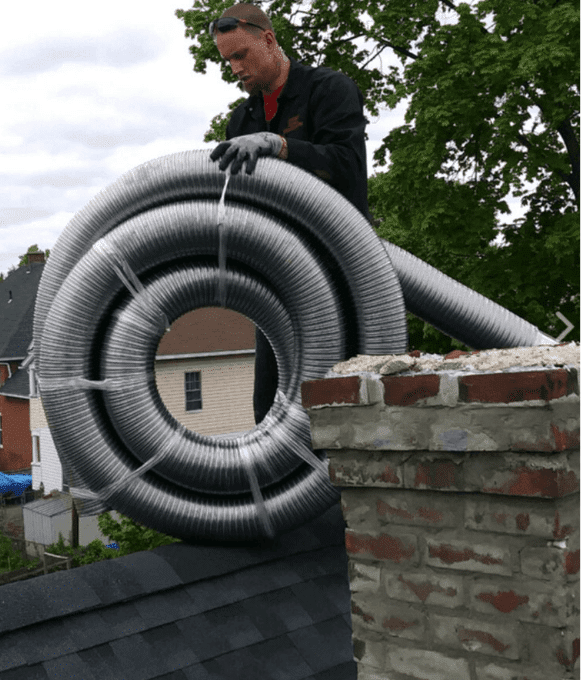
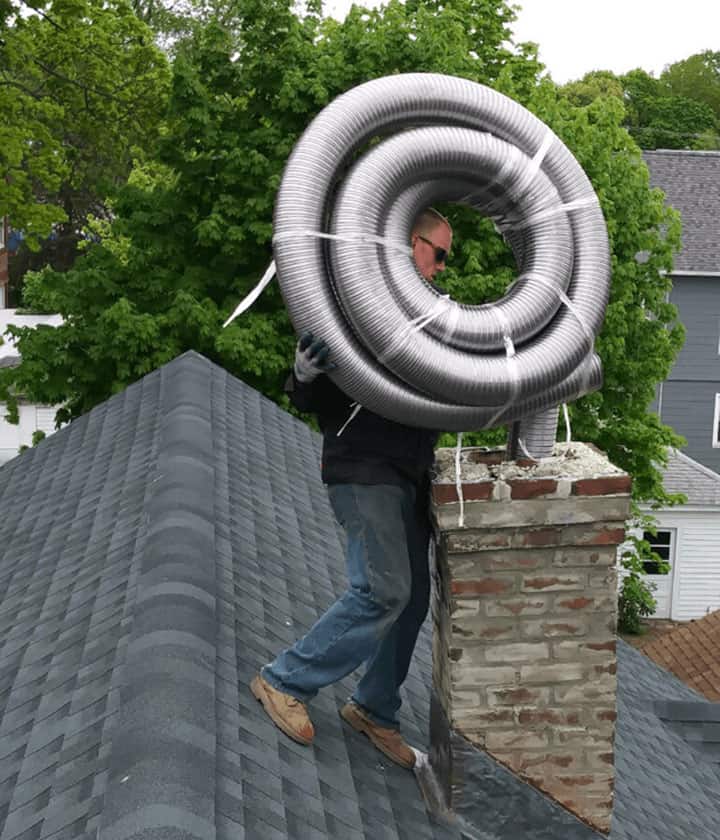
Once the correct liner is selected, the flue is cleaned and prepped, the liner is lowered into place, connected, and secured, insulation is added where required (particularly important for gas appliances), and the termination cap is installed. Before we leave, the system is tested to confirm it functions correctly and meets Rhode Island building codes. That final verification step isn’t universal in the industry — but it should be.
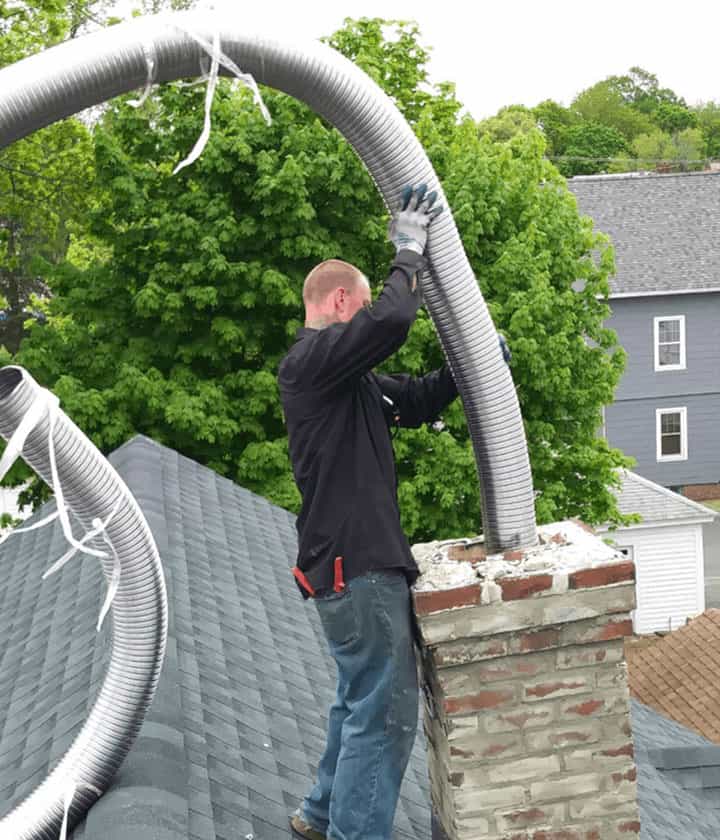
DIY liner kits exist, and they’re marketed online as a straightforward weekend project. The honest answer is that they’re not — at least not for most homeowners, and not without real risk.
Proper liner installation requires accurate flue measurement, knowledge of which liner grade and diameter is correct for the specific appliance, understanding of local building codes and NFPA 211 requirements, and the ability to test the completed system. These aren’t things you can verify by reading an instruction sheet. An improperly sized liner can actually perform worse than no liner at all in certain scenarios, creating dangerous draft conditions or accelerating the buildup of combustion byproducts.
There’s also the code compliance question. Rhode Island building codes govern chimney liner installation, and a DIY installation that doesn’t meet those standards can create problems when you go to sell the home or when your insurance company asks questions after an incident. A professional installation comes with documentation that the work was done correctly and to code — something a DIY kit can’t provide.
The cost difference between a DIY kit and professional installation is real, and we understand that matters. But the gap between what a kit costs and what a professional installation costs is also the gap between a liner that might work and a liner that’s been properly sized, correctly installed, tested, and documented. For a system that’s responsible for venting combustion gases out of your home, that gap is worth closing.
A properly installed stainless steel liner, maintained with regular cleaning and inspection, can last 20 to 30 years or more. Clay tile liners have a more variable lifespan — under ideal conditions they can last decades, but Rhode Island’s climate is not ideal for clay tile. The freeze-thaw cycling alone shortens the practical lifespan significantly, and the acidic condensate from gas appliances does additional damage over time.
The question of when to replace versus when to repair depends on what the inspection actually shows. For clay tile liners with minor cracking and a structurally sound surrounding flue, a ceramic coating repair approach can sometimes extend the liner’s service life without a full replacement. For liners with extensive cracking, missing sections, or significant deterioration, relining with stainless steel is almost always the more cost-effective path — both because the repair materials are expensive and because a ceramic coating can only do so much when the underlying tile is compromised.
One scenario that comes up regularly in Rhode Island is the National Grid shutoff. When a National Grid technician identifies a chimney deficiency during a service call or meter inspection, they can shut off gas service until the chimney issue is resolved. This isn’t a situation where you have the luxury of scheduling something for next season. It requires a certified contractor who can diagnose the problem, complete the required work, and provide the documentation needed to restore service.
We’ve navigated this process for Rhode Island homeowners many times, and it’s exactly the kind of situation where having a team with real experience — and CSIA certification across the board, not just for one person on the crew — makes a meaningful difference. Rhode Island’s climate doesn’t give marginal liners much grace. A liner that’s showing early signs of deterioration in October will be in worse shape by February. Waiting costs more than acting, almost every time.
Rhode Island homes have specific demands — older construction, coastal salt air, and winters that are hard on masonry in ways that colder but more stable climates aren’t. A chimney liner installation done correctly, with the right materials for those conditions and the right technicians handling the work, is one of the more straightforward ways to protect both your home and your heating system for decades.
The short version of everything above: get an inspection before anything else, make sure whoever you hire is actually CSIA-certified (and not just one person on the team), and don’t let a contractor talk you into a liner grade that isn’t matched to your appliance type and your home’s location.
If you have questions about your chimney liner or want to know where things stand before heating season, we offer free estimates and include a chimney inspection with every service. Reach out — we’re straightforward about what you need and honest about what you don’t.
Continue learning: