Summary:
Adding a fireplace or stove to your home sounds straightforward until you start asking questions. What type of chimney do you actually need? Does your existing structure need work before a new appliance can be installed? What does Rhode Island code require? And who, exactly, should be doing this work?
These aren’t small questions. A chimney installation done right can last 40 years and add real value to your home. Done wrong, it’s a fire hazard — and a very expensive one to fix. We’ve been helping Rhode Island homeowners navigate these decisions since 2000, and this guide breaks down what the process actually involves, what decisions you’ll face, and how Rhode Island’s specific climate and building stock should shape those decisions.
Most homeowners come into this decision thinking there’s one kind of chimney. There are really two distinct systems, and the choice between them affects your budget, your timeline, your long-term maintenance costs, and how well the system holds up in a New England winter.
Masonry chimneys are built on-site from brick, block, or stone. They’re the most common type in older Rhode Island homes — the kind you see rising above the rooflines in Providence, Pawtucket, and Woonsocket. They’re durable, classic-looking, and when built well, they last generations. They’re also the more expensive option and require more time to construct.
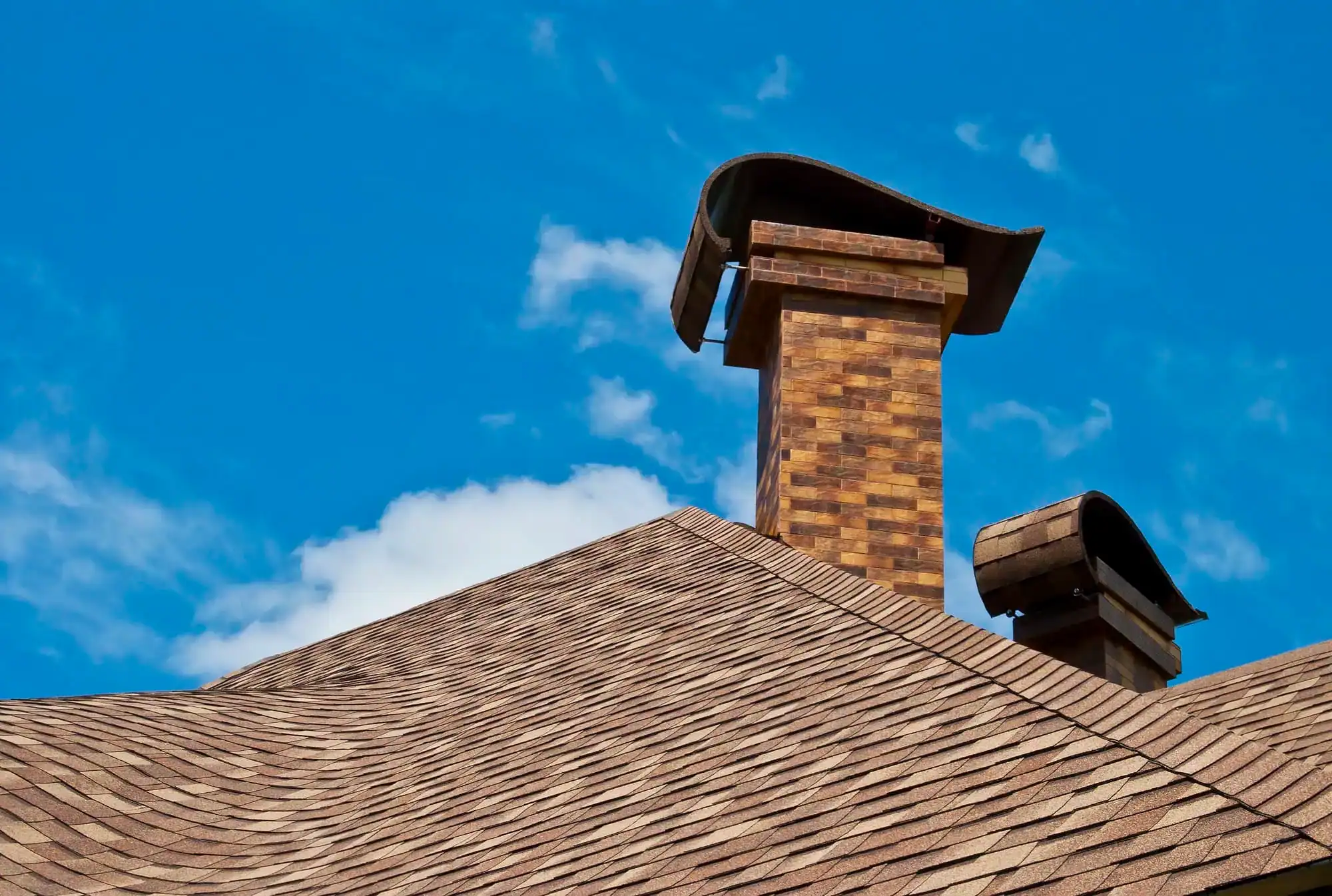
Prefabricated (factory-built) chimneys are engineered systems assembled from manufactured components. They’re faster to install, generally less expensive upfront, and code-compliant when properly installed. The most common type is zero-clearance — meaning the insulated unit can sit directly against combustible framing without creating a fire risk. For homeowners adding a stove or fireplace insert to a home that didn’t previously have one, prefab is often the practical path.

Here’s something most chimney installation guides won’t tell you: the material decisions you make upfront will play out across decades of Rhode Island winters, and those winters are hard on chimneys in ways that don’t apply in warmer climates.
The freeze-thaw cycle is the main culprit. Water works its way into small gaps in mortar joints or chimney crowns, freezes overnight, expands, and fractures the surrounding material. Repeat that process dozens of times each winter and you’ve got spalling brick, cracked crowns, and deteriorating mortar that can compromise the structural integrity of the whole system. It’s not a question of whether this happens — it’s a question of how quickly, and how well your chimney was built to resist it.
For masonry chimneys, this means using the right mortar mix for freeze-thaw conditions, ensuring proper crown construction, and sealing the masonry after installation. Skipping any of these steps isn’t a minor oversight — it’s a decision that will cost you in repairs within a few years.
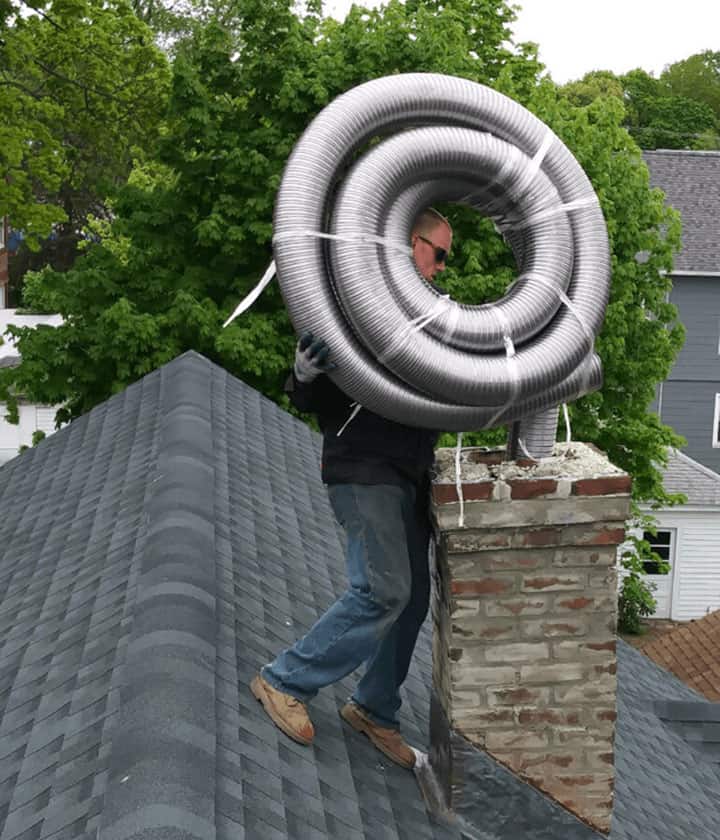
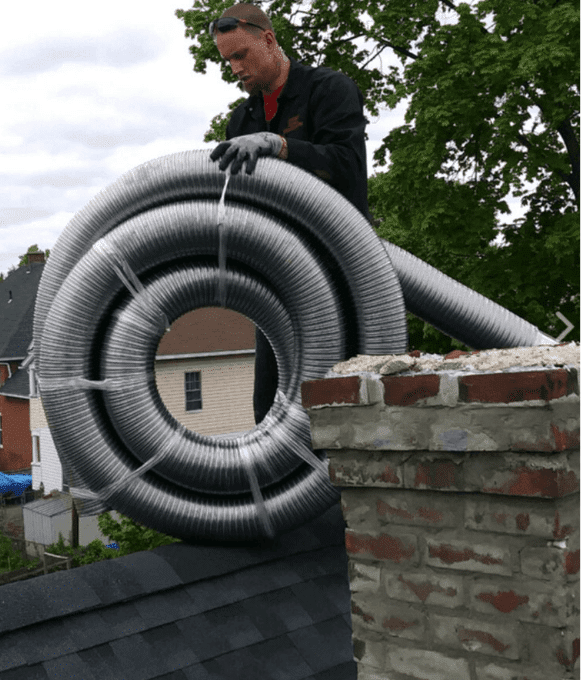
For liner selection, Rhode Island’s climate makes stainless steel a strong choice over clay tile in many applications. Clay tile liners are traditional and widely used, but they’re vulnerable to cracking from thermal shock and moisture infiltration. A properly installed stainless steel liner — especially a flexible liner for existing chimneys — handles temperature cycling better and tends to outlast clay in New England conditions.
If you’re in a coastal community like Newport, Narragansett, South Kingstown, or Barrington, there’s an additional factor: salt air accelerates corrosion of metal chimney components. In these areas, specifying stainless steel for your liner, cap, and any exposed metal components isn’t optional, it’s just the right call for longevity.
The point isn’t to alarm you. It’s that chimney installation in Rhode Island requires someone who understands these conditions and builds accordingly — not a general contractor following a national spec sheet.
Rhode Island has adopted NFPA 211 — the national standard for chimneys, fireplaces, vents, and solid fuel-burning appliances — in both its Mechanical Code and Fuel Gas Code. That’s the governing framework for any chimney installation in the state, and it covers everything from liner material requirements to clearance distances from combustible materials.
Under Rhode Island’s Fuel Gas Code, masonry chimney liners must resist corrosion and cracking from vent gases at temperatures up to 1,800°F. That’s not a suggestion — it’s a code requirement that directly affects which liner materials are acceptable for your specific appliance. The liner you need for a gas fireplace insert is different from what you need for a wood stove running at high output, and getting that wrong creates both a safety problem and a code compliance problem.
Rhode Island’s One and Two Family Dwelling Code also governs clearances — combustible materials must be kept a specified distance from masonry heater surfaces, and the rules around firebox construction, hearth dimensions, and chimney height above the roofline are all spelled out in detail.
What this means practically: new chimney construction in Rhode Island requires permits, and those permits require inspections. If you’re adding a fireplace or stove to a home that didn’t have one, or significantly modifying an existing chimney, you need a contractor who understands the permitting process and builds to code from the start. Unpermitted chimney work doesn’t just create headaches when you sell your home — it can void your homeowner’s insurance coverage if a fire occurs.
One Rhode Island-specific wrinkle worth knowing: National Grid, the state’s primary gas utility, requires documentation from a CSIA-certified technician before restoring gas service after a chimney-related shutdown. If your gas gets shut off because of a chimney issue, you can’t just call any contractor to get it turned back on. You need someone with the right credentials. That’s a situation we see regularly, and it’s one of the reasons CSIA certification matters beyond just the credential itself.
Want live answers?
Connect with a Certified Chimney Inspections expert for fast, friendly support.
The contractor question is where a lot of homeowners make an expensive mistake. Chimney installation looks like construction work, so it’s natural to think your general contractor can handle it as part of a larger renovation. They usually can’t — at least not well.
A general contractor building a chimney from scratch might get the masonry right, but they won’t know how to spec the liner for your specific appliance, they won’t understand the venting requirements for a wood stove versus a gas insert, and they won’t be around in two years when you need an annual inspection or a repair. Chimney installation is the beginning of a long-term relationship with a system that needs ongoing attention — not a one-time construction task.
What you actually want is a CSIA-certified chimney specialist. The Chimney Safety Institute of America certification requires passing a rigorous exam covering chimney science, fire safety codes, venting systems, and installation practices. It’s the industry’s primary credential, and it’s verifiable.
This is one of the most common questions we hear, and it’s a fair one because the scope varies significantly depending on your starting point.
If you’re building a new chimney from scratch — say, adding a wood stove to a home that has no existing fireplace — the installation involves the appliance itself, the firebox or stove platform, the liner running the full height of the chimney, the chimney structure (masonry or prefab), the chimney crown, the cap, and the flashing where the chimney meets the roof. Each of these components has to be specified correctly for the fuel type and appliance output, and they all have to work together as a system.
If you’re upgrading an existing chimney to support a new appliance — a common scenario in older Rhode Island homes where someone is switching from oil heat or adding a pellet stove as supplemental heat — the scope might be more limited. You might need a new liner and cap without touching the masonry structure. Or the masonry might need repair work before a liner installation makes sense. A proper inspection tells you where you actually stand.
The chimney and the appliance have to be designed together. The liner diameter has to match the appliance’s flue collar size. The chimney height affects draft, which affects how well the appliance performs and how much creosote accumulates. These aren’t details you can sort out after the fact — they have to be right from the start.
One thing that sets our approach apart: we operate a retail stove store, which means we can help you select the right wood, pellet, or gas stove for your home’s heating needs and then install the correct chimney system for that specific appliance. There’s no disconnect between the person who sold you the stove and the person responsible for making the chimney work with it. That matters more than it might seem.
Cost is usually the first question, and the honest answer is that it depends on a range of factors — but there are real numbers to work with.
Most chimney installations fall somewhere between $3,250 and $9,500. A masonry chimney at 30 feet typically lands in the $4,000 to $8,000 range, with most homeowners paying around $6,500. Prefabricated systems for the same height start around $3,500 and can run higher depending on the components specified. Prefab chimney pipe generally runs $100 to $150 per linear foot. A closed-hearth wood-burning fireplace with installation typically falls in the $4,000 to $12,000 range including materials.
Several factors move that number up or down. Chimney height is a big one — taller chimneys require more materials and more labor. The fuel type affects liner selection and cost. Whether you’re building new or modifying an existing structure changes the scope significantly. And the condition of your existing masonry, if there is any, affects how much prep work is needed before installation can begin.
We provide free estimates, and our quotes are straightforward — what the work involves, what it costs, no hidden fees added at the end. For larger projects, we also offer in-house financing through the GreenSky® program. Major chimney installations aren’t always planned expenses, and we’d rather help you get the right system installed now than have you defer a safety project because of budget timing.
One thing worth knowing from a long-term perspective: a properly installed fireplace or stove can add $1,000 to $5,000 to your home’s resale value, particularly in colder climates like Rhode Island’s. It’s not just a comfort upgrade — it’s an investment in the home itself.
The right chimney system for your Rhode Island home depends on your fuel type, your appliance, your existing structure, and the specific conditions your chimney will face — coastal salt air, freeze-thaw cycles, and all the rest. There’s no universal answer, but there is a right answer for your situation, and it starts with talking to someone who actually knows the difference.
We’ve been doing this work with the same team since 2000. Our technicians are CSIA-certified, we run a retail stove store so the appliance and the installation stay in sync, and we offer free estimates so you know what you’re looking at before committing to anything.
If you’re thinking about adding a fireplace or stove, upgrading an existing chimney, or just trying to understand what your options are, reach out to Certified Chimney Inspections. We’ll give you a straight answer.
Continue learning: