Summary:
Most homeowners don’t think about their chimney until something obvious goes wrong. A crack appears. Water shows up near the fireplace. A strange smell lingers that wasn’t there last winter. By that point, the damage has usually been building for a while, quietly hiding behind mortar joints and inside the flue where no one is looking. If you’re asking yourself if it’s time to have someone take a look, that question alone is worth paying attention to. This post will walk you through what the real warning signs look like, why Rhode Island’s climate accelerates wear and tear, and what a thorough chimney inspection reveals.
The warning signs homeowners notice, such as visible cracks, white staining on the brickwork, or water pooling near the firebox, are rarely the beginning of the problem. They are usually the middle stage. By the time something is visible from the ground or inside your living room, the underlying issue has often been developing for a season or two already.
That’s not meant to cause panic; it is simply the reality of how masonry structures fail over time. The components that matter most, including the liner, the mortar joints, the crown, and the flashing, are either out of sight or easy to overlook. Knowing what to look for and understanding what each sign means is the first step toward catching issues before they turn into major expenses.

White staining on the outside of your chimney, known as efflorescence, is one of the clearest early signals. It looks like a chalky residue on the brick, showing that water is migrating through the masonry and carrying dissolved mineral salts to the surface as it evaporates. Many homeowners assume it’s purely cosmetic, but it isn’t. It is clear evidence that moisture is actively penetrating the structure, and in Rhode Island’s climate, moisture problems compound rapidly.
Spalling is another major warning sign. That occurs when the face of a brick begins to flake, chip, or pop off, which happens directly when trapped water freezes and expands inside the brick itself. Once spalling starts, it tends to accelerate quickly because each freeze-thaw cycle breaks the material down further. Homes in Bristol County along the bay, older neighborhoods throughout Providence County, and waterfront properties in Newport County see this pattern constantly due to the harsh combination of moisture exposure and rapid temperature swings.
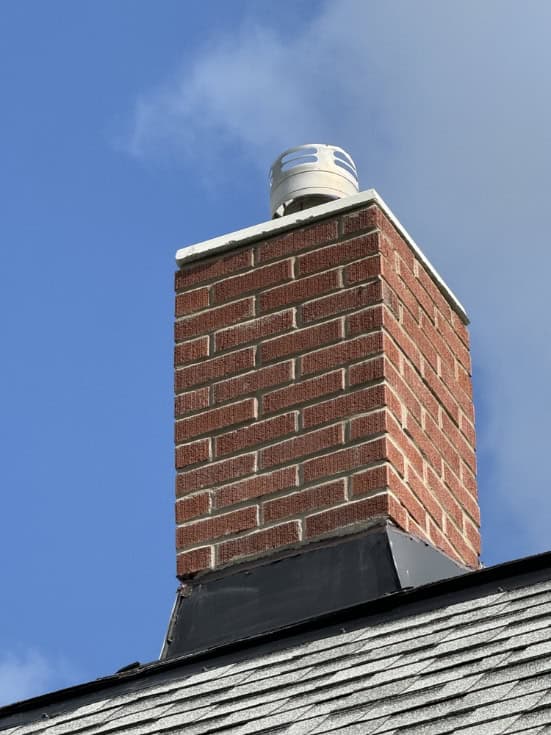
A cracked or deteriorating chimney crown is easy to miss from the ground, yet it is one of the most common entry points for water damage. The crown is the protective concrete slab sealing the top of the chimney stack. When it cracks, as unsealed crowns eventually do, rain runs directly into the masonry below. By the time water stains show up inside near the fireplace, the crown has often been leaking for multiple seasons.
Mortar joint deterioration is even subtler. Mortar is deliberately softer than brick, meaning it absorbs the brunt of freeze-thaw stress. As mortar erodes or cracks, it opens direct channels for water to seep deeper into the chimney core. Tuckpointing, the process of raking out damaged mortar and replacing it with fresh compound, is one of the most frequent chimney repairs we perform across Kent County and Providence County, particularly on older homes where the original masonry hasn’t been serviced in decades.
Interior signs are just as critical: a smoky odor when the fireplace is unlit, a fire that struggles to draw properly, or bits of soot and debris falling into the firebox. These symptoms frequently point to flue liner damage, draft restrictions, or blockages, none of which can be evaluated safely without specialized inspection equipment.
Rhode Island’s maritime climate creates a persistent battle for masonry chimneys. The state sits in a temperature zone where winter days repeatedly swing back and forth across the freezing point. It doesn’t stay consistently frozen like an inland northern territory, nor does it stay mild like a southern coast. That constant transition zone is where freeze-thaw damage is at its most aggressive.
Here is the underlying mechanism: water from winter rain, melting snow, or coastal fog settles into micro-cracks along mortar joints, penetrates porous bricks, and slips beneath lifting flashing. When temperatures dip below freezing, that trapped moisture expands. When temperatures rise, it thaws and contracts. Over a single Rhode Island winter, this cycle repeats dozens or even hundreds of times. Each cycle pushes the masonry slightly wider, turning what began as a hairline fracture in October into a visible gap by April.
For homeowners in coastal Washington County communities like Narragansett, South Kingstown, and Westerly, salt air introduces another destructive element. Salt accelerates corrosion on both masonry binders and essential metal components, including chimney flashing, dampers, and steel flue liners. Coastal exposure speeds up deterioration on a timeline that often surprises homeowners who expect chimneys to last decades without maintenance.
The practical reality is straightforward: if your chimney hasn’t been professionally evaluated within the past year, you cannot be certain what the previous winter cost you structurally. That isn’t an exaggeration; it is simply how brick and mortar react to our local environment. The NFPA 211 standard, the nation’s leading benchmark for chimney safety, recommends annual inspections for this exact reason. The goal isn’t to find an emergency every year, but to recognize small defects before they compromise your home.
Want live answers?
Connect with a Certified Chimney Inspections expert for fast, friendly support.
When a homeowner calls our team, our first task is to diagnose rather than quote. That distinction matters. Quality chimney repair begins with pinpointing the root cause of the breakdown, not presenting a pre-packaged sales pitch. Our technicians thoroughly document their findings with clear photos and video scans so you can see the precise condition of the chimney yourself.
Professional repair covers a wide spectrum of work tailored to the findings. Work might include crown resurfacing or rebuilding, tuckpointing degraded mortar joints, installing a new stainless steel flue liner, resealing flashing, or halting water infiltration across multiple vulnerable spots. Sometimes the solution is a fast, targeted maintenance task; other times, structural rehabilitation is necessary. Either way, you receive complete clarity on the project scope and options before any repair begins.

This is one of the most common questions we receive, and it is entirely reasonable. The answer comes down to the extent of the damage, the age of the structure, and the remaining stability of the masonry. Most chimneys do not need to be completely torn down; they need precise repairs focused on the specific components that have degraded.
Tuckpointing, crown rebuilding, custom relining, and flashing replacement are repair-level solutions that add decades of service life when the core structure remains sound. A full chimney rebuild only enters the conversation when the structural integrity is compromised beyond safe spot repair, such as when brickwork has completely loosened down through the roofline or the chimney’s foundation has shifted.
For historic properties, which are widespread across Newport’s historic districts and Providence’s classic neighborhoods, chimneys were often built long before modern fire-containment and waterproofing standards existed. In these settings, a chimney that looks completely solid from the yard might have an unlined flue or clay tiles that have completely disintegrated inside. That scenario calls for a dedicated relining and safety retrofit rather than simple cosmetic masonry work, ideally handled before the winter burning season begins.
You cannot make this call from the ground. A Level 1 visual check covers basic external and accessible areas, while a Level 2 video inspection thoroughly scans the interior flue walls for cracks and voids. Level 2 evaluations are required during property sales or after severe weather events, and our technicians perform both to give you an objective, unvarnished assessment.
Homeowners frequently ask if a chimney that worked without incident last season is safe to fire up again without an inspection. The short answer: not necessarily. Because Rhode Island winters are notoriously tough on masonry, unseen damage can develop quietly over just a few cold months. Relying on the idea that “it was fine last year” leaves your home vulnerable to hidden cracks and creosote buildup.
Another frequent question is if homeowners insurance pays for chimney repairs. Generally speaking, standard policies cover sudden, accidental incidents, such as lightning strikes, major windstorms, or chimney fires. Ongoing deterioration from age, damp coastal air, or deferred maintenance is routinely excluded. That makes routine maintenance essential, as resolving small problems promptly keeps repair bills modest and keeps your home fully insurable.
Clients also ask if building permits are required for chimney work in Rhode Island. The answer depends entirely on the scope of the project. Routine tuckpointing and surface crown sealing rarely require permits. Structural overhauls, major relining, and total rebuilds usually require municipal approval. Our team manages local code compliance and the permitting process across Bristol, Kent, Newport, Providence, and Washington counties so you don’t have to deal with the paperwork.
Homeowners in Washington County and coastal Newport frequently inquire if leaving a house vacant for part of the year affects chimney health. It certainly does. Idle chimneys easily attract nesting wildlife, accumulate interior condensation, and experience quiet masonry movement while the home is unoccupied. If you are opening up a seasonal cottage or returning to a secondary property, scheduling an inspection before lighting the first log is a crucial safety step.
People also want to know how long a repair project takes. Minor tasks, such as tuckpointing, flashing repairs, crown resurfacing, or cap installations, are normally wrapped up in a single day. Larger projects like complete flue relining or rebuilding upper masonry sections take a bit longer depending on weather conditions. We always provide a firm, dependable schedule upfront before starting work.
If you’ve spotted any of the warning signs outlined here, or if you simply cannot recall the last time a certified sweep looked inside your flue, taking action now is the smart move. Rhode Island’s coastal climate offers little relief to aging brickwork, and the issues that quietly develop between seasons will only escalate if ignored. The good news is that most chimney problems are quick and economical to resolve when caught early. To protect your home and ensure your fireplace is completely safe for the coming season, contact Certified Chimney Inspections today to schedule your comprehensive chimney inspection and free repair estimate.
Continue learning: